
Seaweeds are magnificent in so many ways, and we write often about the benefits of seaweed. However, seaweeds should grow where seaweeds are meant to grow. Seaweeds shouldn’t grow where theyre not meant to. It sounds obvious! However, with the influx of nutrients from agriculture and other sources, and rising stresses on coral reefs from climate change and ocean acidification, these unbelievably beautiful and critical environments are under threat from excessive seaweed growth.
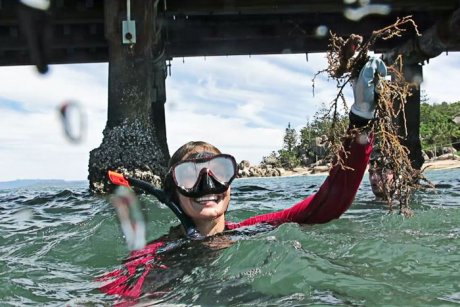
Students from The Ohio State University enjoying helping with the removal and showing beneftis of seaweed tourism. ABC NORTH QLD: HARRIET TATHAM
In parts of Australia they are responding by promoting the benefits of seaweed tourism to clean up coral reefs.
As a brief marine biology lesson, coral reefs grow in clear and low nutrient waters. They survive and prosper through symbiosis with micro algae (zooxanthellae) that live within the coral (which are animals). As such, the coral, as animals, produce nutrients and carbon dioxide, which is in turn used by the algae. Along with the bright sunshine, the algae use these animal wastes to photosynthesise to produce oxygen and sugars that can be used by the coral. It’s an incredible system. However, as nutrient levels increase through pollution, agricultural run off and other sources, and the coral is stressed as well from rising sea temperatures and ocean acidification, the environment becomes harder for the corals and more suited for seaweeds.
Seaweeds love high nutrients and high light levels, and with coral less able to thrive and defend its habitat, we are seeing the reefs struggle and this then impacts on the countless species that depend on a healthy coral reef.
Fact: Did you know that coral reefs take up just 0.2% of the ocean, yet support around 25% of the World’s fish biodiversity! That is how essential they are to promote and maintain diversity, sustain healthy fisheries so we can all eat, and be part of regulating our wider seas and climate.
The Benefits of Seaweed Tourism
By diving on reefs and collecting up the seaweed, tourists can not only have an extremely enjoyable dive, but also help to improve the reef’s health. Some have compared this seaweed collection to collecting litter on the beach.
It is difficult for us to write about seaweed in a negative way, but really its not the seaweed’s fault, it is our fault!
The benefits of seaweed are well known for health, nutrition, salt replacement and more besides. It is a highly sustainable food of the future, and as part of conserving out natural environment in the face of climate change and the rising global human population (who all need to eat, and we hope eat healthily).
Please support marine conservation such as the Marine Conservation Society and others. Please also act responsibly, using less plastic and disposing of it properly, as plastic pollution is another huge threat to the marine environment.
If you want to discuss any aspects of this article with us, please get in touch. We are always delighted to talk about making our marine environment a better place, and doing so in a realistic and commercially relevant manner. This is one of the key drivers for setting up Seaweed & Co.