Iodine Status in Africa
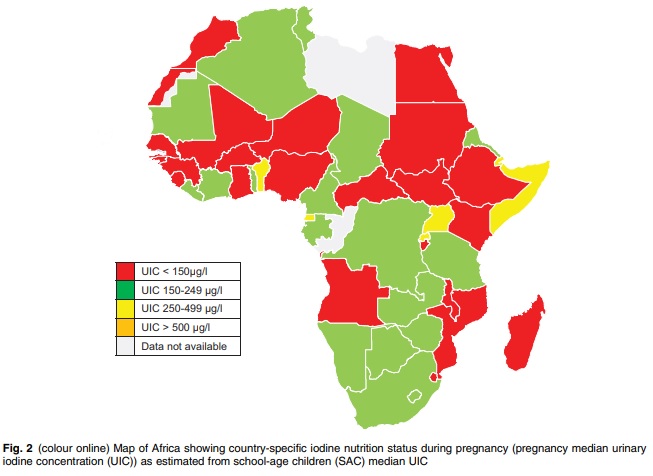
A study from the University of Cape Town has looked to assess the level of iodine deficiency within the African countries that are classed as iodine sufficient. It was reported that in 1995, 89% of the African population were at risk of iodine deficiency. The main approach to tackling these findings was to roll out a nationwide universal salt iodisation programme. The current system for monitoring the iodine levels of the population is through results derived from school children. However, one criticism for this approach has been that it does not allow for a correct predication for the iodine status of pregnant women. Inadequate iodine status during pregnancy can cause a range of adverse outcomes such as – but not limited to – still births and cognitive abnormalities.
About the Study
The World Health Organisation (WHO) state that anything below 150 micrograms per day is insufficient. This recommendation is higher during pregnancy and the requirement is 100 micrograms higher. In this study, the researchers estimated the nutrition during pregnancy using the statistics generated from the most recent Iodine Global Network (IGN) 2019 score card. The IGN publish a score card for most countries every 2 years. From the data available from the 2017 score card, 65 counties (including 11 in Africa) showed data for school children and women during pregnancy. This was used to generate regression equation which would be used to predict the level of deficiency throughout the countries within Africa.
What do the Results Show?
22 out of the 44 countries that were assessed were found to have inadequate iodine intake during pregnancy. These findings are alarming. They highlight that the current method of assessing population iodine status could be ineffective, especially for those who are pregnant. From the original data, 40 out of the 50 African countries are classed as adequate. However, from the findings in this study it would suggest that, regarding pregnancy, half of those countries simply weren’t getting enough. Salt iodinisation has proved useful at combatting insufficiency for the general population but further methods – such as supplementation – may be required during pregnancy.
Iodine and Pregnancy
Iodine Status during pregnancy is important because they both go hand in hand. That’s because iodine is an essential nutrient for human health throughout the life cycle. It is arguably most important during pregnancy and foetal growth as it plays roles in building the nervous system and cognitive development. The finding in the African study are similar to those that were reported in an Israeli study earlier this year. Israel also use salt iodisation to tackle iodine deficiency. The Israeli study (we reported on this in a previous blog and can be found here) found that despite the measures in place, 67% of the 134 participating pregnant women in the study were found to have insufficient iodine status.
You can find the African study here.
You can find our blog about the Israeli study here.